
Overview – Digital catalogue
'Mapping the EGO', Boa Mistura
Artist: Boa Mistura
Dates: June 4th 2026, to July 17th 2026
The history of humanity within the history of art is measured and studied through the traces that we leave behind. From the Paleolithic Age to the Contemporary era, the idea of permanence has been deeply rooted in the human psyche, but what does it mean today to leave our mark?
“MAPPING THE EGO” emerges from the impulse to occupy, to exist, and to leave an imprint. The Boa Mistura collective has its roots in graffiti, where a signature functions as a marker of identity that asserts the author’s presence in public space. Since its emergence in New York around the 1960s, modern graffiti has acted as an alternative means of communication through the blending of artistic and social aspects. However, this form of expression would not be the same without a key element: the wall.
The wall, a symbol of limitations and barriers, becomes in urban art a medium for dialogue with the city, a way of reclaiming a space often controlled by institutional power. Throughout the 20th century, few examples have embodied this tension as clearly as the Berlin Wall: a physical and political boundary that, paradoxically, also became one of the most emblematic surfaces for graphic expression and graffiti. Through intervention and reappropriation, artists and citizens transformed a symbol of division into a space for collective expression, decentralized and universal.
The concept of the “imaginary museum” by French writer André Malraux describes a way of accessing art without the need for physical presence in museums. This “museum without walls” is accessible to everyone, not through imagination, but through images. Although Malraux refers to the photographic reproduction of artworks, this idea can also be applied to graffiti: the signature, or tag, is reproduced until it becomes a recognizable image that circulates and appears in multiple urban contexts. As with photographs in the imaginary museum, each new intervention bestows the work with its own meanings, granting it a certain autonomy from a fixed context.
In this process, the repetition of the signature across different spaces acquires an identity-related dimension: it is a gesture of presence that allows the author to exist in urban space and to be recognized by the community.
In psychology, Carl Gustav Jung defines the ego as the center of conscious identity and self-affirmation; it enables us to recognize and assert ourselves in relation to the world. The project “MAPPING THE EGO” takes this idea as its starting point and explores the relationship between identity, fragmentation, and space.
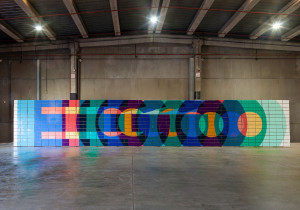
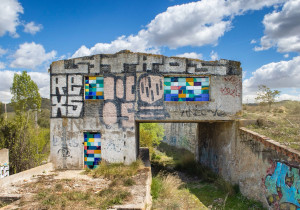
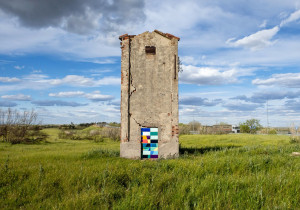
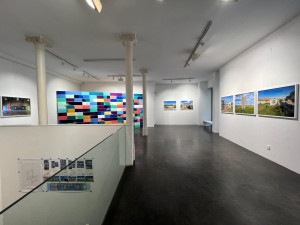
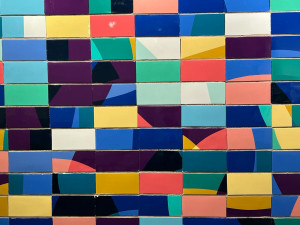
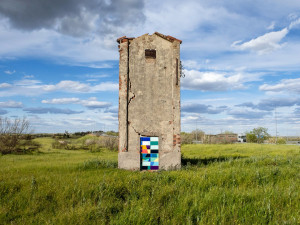
Beginning with an initial mural conceived with a defined formal order, it is then fragmented into a series of bricks that function as the minimum unit of the wall: autonomous fragments that are part of a whole. Together they form the word “EGO” in a kinetic harmony, where the letters shift and overlap. Each piece retains part of the original image but also acquires autonomy as it separates from the whole.
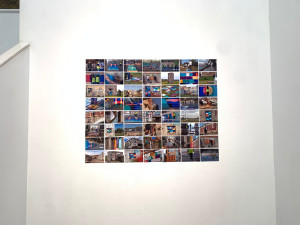
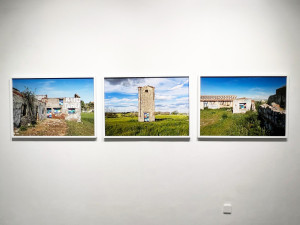
During a series of interventions in the outskirts of Madrid, these fragments are installed on the walls of
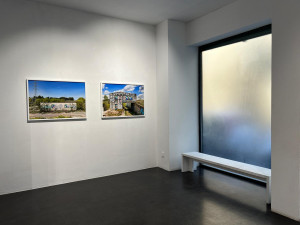
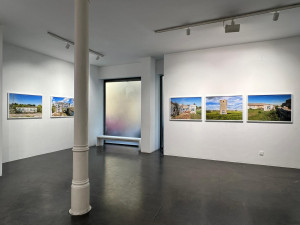
abandoned buildings, temporarily integrating into new urban surfaces and leaving a subtle trace of their presence. National highways become the territory for these intervened ruins, where the bricks are placed to merge into the landscape of tags that accompany road journeys. With each intervention, new configurations and meanings emerge, evoking how individual identity is inscribed and collectively reconstructed in relation to the space that surrounds it.

Exhibitions's artists
‘Mapping the EGO’, Boa Mistura
June 4th 2026 to July 17th 2026

‘UBUNTU’, Boa Mistura
April 27th 2023 to July 14th 2023

‘Vida’, Boamistura
June 2nd to July 13th

‘Mi raíz es’, Boamistura
June 1st to July 17th, 2016

‘Anaformosis’, Boa Mistura
March 20th-29th, 2014