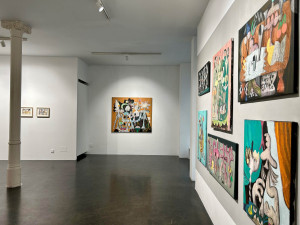
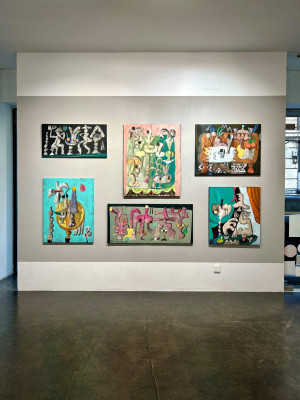
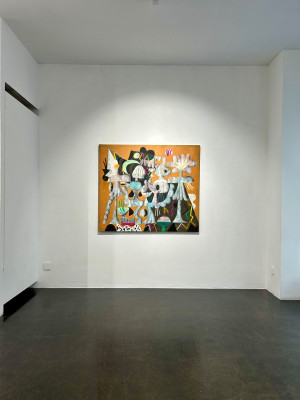
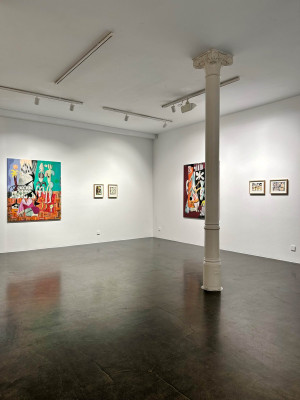
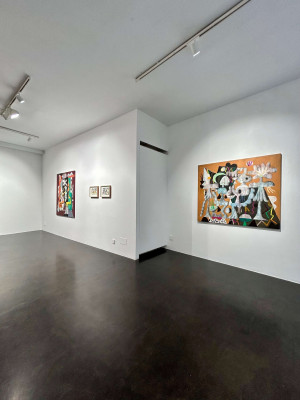
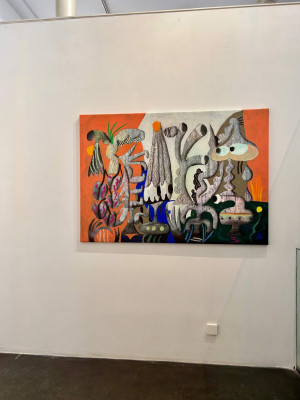
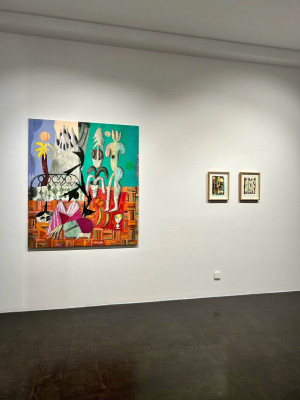
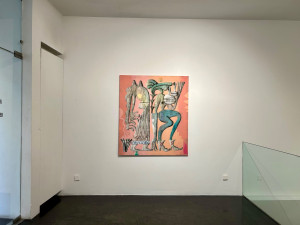
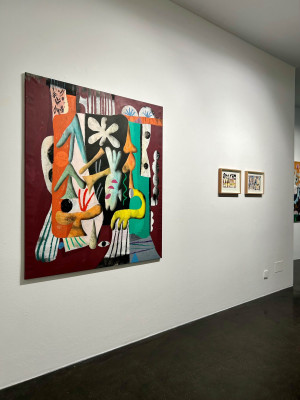
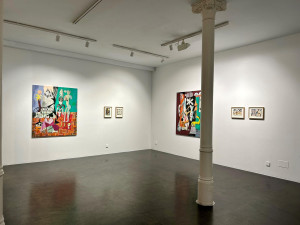
'Before Dinner', József Csató
Artist: József Csató
Dates: April 16th 2026 to May 22nd 2026
Few spaces in everyday life carry as much meaning as the domestic environment. And yet, it is also one of the most invisible. We rarely notice it while it performs its function: holding objects, organizing gestures, containing conversations. But it is precisely there — within the seemingly trivial — that many of the fundamental scenes of human life unfold.
The title of this exhibition — Before Dinner — places the viewer in a moment that precedes the event itself: a suspended time in which something is about to happen. Not the event, but its imminence. A state of preparation and anticipation, where objects are already in place and presences have not yet fully settled.
In the recent paintings of József Csató, such scenes appear as open constructions where the domestic merges with the imaginary. Tables, objects, figures, and fragments of interior life are arranged in compositions that oscillate between figuration and its dissolution. What is at stake is not the depiction of a specific moment, but the activation of a space in which multiple temporalities and states can coexist.
As in much of his work, Csató operates within a constant tension between structure and disintegration. Forms do not remain fixed; they expand, contract, and intertwine with the space of the canvas itself. Within this flow, certain elements — a table, an object, a surface — act as points of orientation, but never as closed centers of meaning.
In this sense, his work can also be read in relation to the tradition of the still life, understood not as a static genre but as a field of experimentation in which objects acquire an active presence. From Dutch still lifes to the domestic compositions of Bonnard or Matisse, the everyday has long served as a site for reflecting on form, time, and perception.
Yet in Csató’s painting, this tradition shifts toward a more unstable terrain. Objects are not presented as ordered elements within a recognizable scene, but as fragments participating in a more fluid, almost mental logic. What we see is less a fixed arrangement than a state in transformation.
The result is a body of work in which intimacy does not appear as something closed or narrative, but as a layered and complex territory. Domestic spaces cease to function as neutral settings and instead become sites where memory, imagination, and perception intersect.
In this context, the “before” invoked by the title is not merely chronological. It is also a condition — a state of latency in which things have not yet fully taken shape. Objects, figures, and space seem to hold a quiet tension, as if suspended on the edge of becoming.
Perhaps it is precisely this tension that runs through these paintings. Not what happens, but what is about to happen. Not the scene itself, but its possibility.
In Before Dinner, Csató reminds us that painting is not only a place where things are shown, but a space where they remain unresolved. Where experience has not yet fully settled.
And it is in that interval — between what is and what is about to emerge — that the image begins to think.