'Inner nature', Chiqui García
Artist: Chiqui García
Dates: March 04th 2026 to April 10th 2026
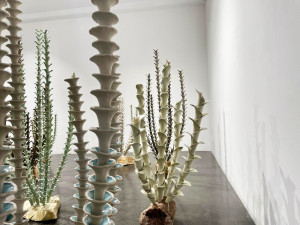
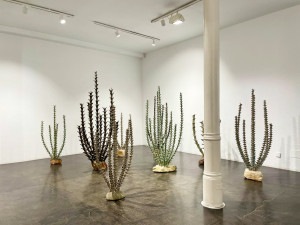
Chiqui García’s work (1979) can be read as a silent — yet firm — response to one of the central dilemmas of contemporary art: how to produce meaning in an accelerated world without resorting to spectacle or empty abstraction? At this point, the artist naturally inscribes himself within the genealogy of those movements that, since the second half of the twentieth century, restored an active status to matter.
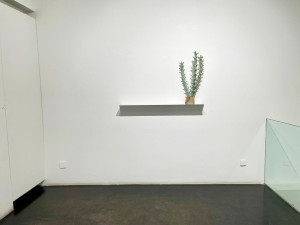
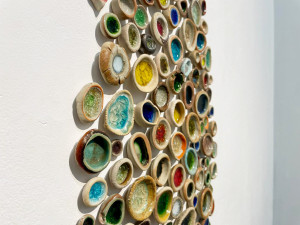
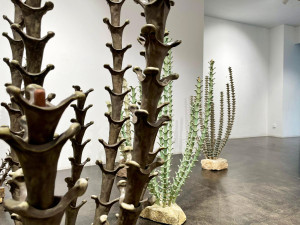
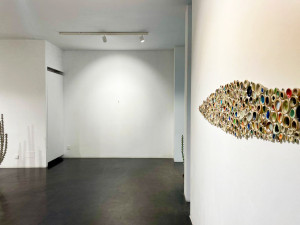
As in Arte Povera, the choice of materials here responds to an ethics of formal economy. Ceramics, reclaimed wood, stone extracted from mining contexts are territories charged with time and memory. However, unlike the more confrontational gestures of that tradition, the dramatic tension between nature and system gives way to a relationship of continuity, because matter becomes an interlocutor.
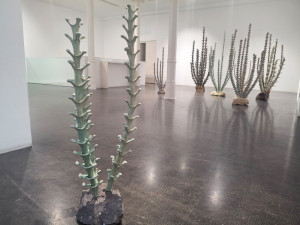
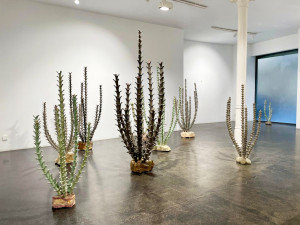
His work also engages with the idea of art as an expanded experience, articulated from Joseph Beuys to later developments in relational thought, because the experience is produced through attention. In this way, his works demand a specific time: that of slow observation, circling, and bodily proximity. The viewer’s body is summoned as presence.
This bodily dimension connects his practice with that phenomenological understanding of art in which meaning emerges in the relationship between form, space, and perception. The human body, although rarely represented, is always implicated. The pieces move with the wind, are assembled and disassembled according to that active variable that is time.
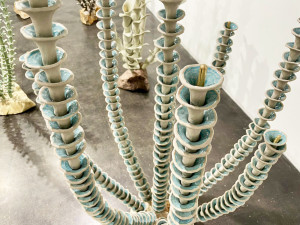
Against the hegemony of the digital and the immaterial, García insists on the hand. Richard Sennett wrote that craftsmanship is an intelligence built through practice, and the hundreds of pieces molded by García, one by one with minimal variations, embody that idea. Imperfection, then, is not symbolic resistance but a condition of the living. As in nature, where nothing is identical and everything belongs to the same system.
Here it is also necessary to point out his particular relationship with beauty. Far from immediate impact or formal seduction, his is linked to balance and well-being. Close to the Platonic tradition, yet reformulated from a contemporary sensibility that does not concern an abstract ideal but a concrete experience produced in the encounter with the work.
Adorno already stated that the true artwork does not accommodate the world as it is, that it preserves in its form the possibility of another rhythm. García’s operates precisely within that register: it does not denounce, it does not explain, it does not accelerate. From his origins in Malargüe, Mendoza, to Lima, from Zurich to Madrid, the artist’s practice unfolds without stridency, maintaining a rare coherence within the system of contemporary art.
Thus, in a field saturated with discourse, his low profile continues to propose something more difficult and necessary: an experience in which matter thinks, time allows itself to be shaped, and art once again becomes that inhabitable place.
— Czar Gutiérrez
CHIQUI GARCÍA (Argentina, 1979)
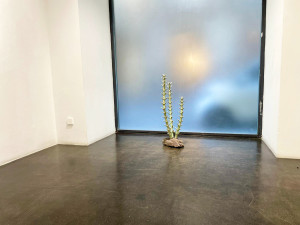
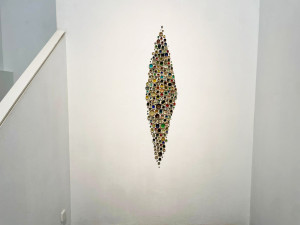
Beyond the dictates of time, his hand glides in order to let the gaze rest upon that “nature” others have ceased to see. His art approaches grass, the head of a reed, a bean, the reflection of a broad bean. He also sculpts, one by one, the parts of a succulent plant, transporting us to another sphere of life, linked in series, where each piece traces its aura upon the gaze of the thirsty, the voracious, of the one who never stops. When his objects intertwine with your life, a unique experience touches the body, like a subtle chord inviting you to become its neighbor.
It is not without music that his carving finds its place in wood — wood that was on the verge of suffering the fate of discard — intervening only those veins, perhaps ribs, in order to rise again and return once more to the landscape.
The minute ceases to be ephemeral; the small recovers, through its imprint, that beauty once thought lost. Born in Malargüe, Mendoza, Argentina, Pablo “Chiqui” García showed from an early age a remarkable interest and aptitude for art, creating sculptures in brick, wood, and various materials. A self-taught artist, he works across multiple forms of expression such as music, sculpture, performance, and ceramics, with a focus on ecological and spiritual themes.
With more than 20 years of career, García has developed a distinctive style characterized by creativity, innovation, and a profound sense of dedication and passion, evident in each of his works. He has participated in solo and group exhibitions in Latin America and Europe, and has undertaken artistic residencies in Colombia, Bolivia, and Switzerland.
Since 2016, his work has been developed between Zurich, Switzerland; Mendoza, Argentina; and Lima, Peru.